
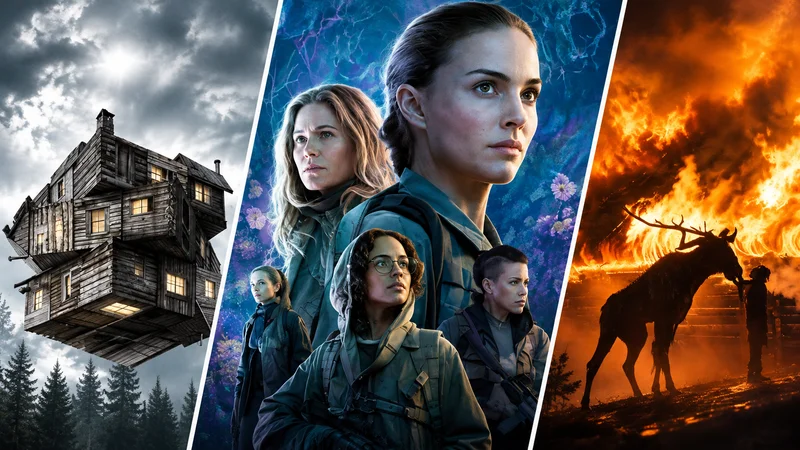
The best cosmic horror movies confront an unnerving possibility: the universe is older, stranger, and far less interested in humanity than we imagine. An impossible organism can imitate a friend, a book can rewrite reality, or an unexplored landscape can change the rules of life itself. This Top 35 spans early Lovecraft adaptations, influential science-fiction nightmares, and inventive independent films through 2023.
For readers exploring genre recommendations at NetShort, cosmic horror is not simply a synonym for monsters with tentacles. What matters is the encounter with forces that exceed human understanding or control. Some selections are unmistakable examples; others are thoughtful crossovers with alien horror, body horror, or surreal experimental cinema. The viewing cues below explain those differences without revealing major endings.
The best cosmic horror movies can be deeply frightening without providing an answer to every mystery. Each entry offers quick facts, a spoiler-conscious premise, and a reason to watch. Graphic bodily harm, sexual material, suicide-related themes, and existential despair appear in some titles, so choose according to your comfort level. The numbers organize the recommendations rather than present an objective fear ranking.
Why Does Cosmic Horror Feel Different?
- The unknown: A threat may have motives or laws that humans cannot comprehend.
- Insignificance: Individual lives matter emotionally, yet the surrounding universe may not care.
- Forbidden knowledge: Investigation can make people less safe rather than bringing reassurance.
- Unstable reality: Space, time, biology, or identity may change without an understandable cause.
- Subgenre range: Direct Lovecraft adaptations, alien encounters, folk rituals, and experimental cinema can share the same existential fear.
The best cosmic horror movies do not need a single monster design or literary reference. H. P. Lovecraft made cosmic insignificance a major element of his fiction, but contemporary filmmakers also approach it through ecological change, absurd humor, and the loss of trustworthy evidence. This guide favors movies whose mysteries challenge humanity’s place in a larger system, while flagging entries that lean more heavily toward adjacent genres.
Essential Cosmic Nightmares and Unknowable Worlds
The best cosmic horror movies often begin with something practical: a research mission, an ordinary job, or an attempt to rescue someone. These seven accessible landmarks let overwhelming uncertainty grow from a clearly defined situation.
1. The Thing (1982)
- Style: Antarctic alien paranoia
- Tone: Suspicious, isolated, and grotesque
- Best for: Viewers who like distrust and practical effects
John Carpenter strands an American research team in Antarctica with an organism capable of copying other living things. The crew discovers that a familiar face is no guarantee of safety, so every argument and medical test carries the possibility of catastrophic betrayal. Kurt Russell leads an increasingly desperate ensemble that cannot retreat into the surrounding wilderness.
Rob Bottin’s physical transformations are astonishing, but the deeper terror is epistemological: no one can be sure what they are seeing or who remains human. The creature has no understandable motive to negotiate with. This is the 1982 film, not the 1951 version, and it is an especially strong entry point for cosmic horror.
2. Alien (1979)
- Style: Industrial space survival horror
- Tone: Patient, claustrophobic, and merciless
- Best for: Fans of hostile extraterrestrial biology
Ridley Scott follows the commercial spacecraft Nostromo after its crew responds to a mysterious transmission. An encounter on a desolate world brings an unfamiliar organism aboard, and the workers gradually realize their ship is a dangerously confined place to meet it. Sigourney Weaver’s Ripley must contend with the creature and decisions made by people who do not share her priorities.
Alien is a science-fiction creature film with a compelling cosmic-horror dimension: the universe contains life whose biology makes human assumptions irrelevant. H. R. Giger’s designs suggest a civilization and ecology the crew cannot comprehend. It offers more concrete survival action than philosophical cosmic horror, making it approachable without weakening its existential unease.
3. In the Mouth of Madness (1994)
- Style: Reality-warping literary nightmare
- Tone: Hallucinatory, paranoid, and playful
- Best for: Readers who enjoy metafiction and uncertain reality
John Carpenter follows insurance investigator John Trent, played by Sam Neill, as he searches for vanished horror novelist Sutter Cane. The writer’s stories appear to be changing the people who encounter them, and Trent’s investigation leads toward a town that seems strangely connected to the fiction. Everyday distinctions between a book, a reader, and the outside world begin to collapse.
Rather than adapting a single Lovecraft story, the film embraces the idea that human reality may be fragile beside forces we cannot name. Its altered geography, unstable images, and sly humor make it a particularly direct expression of cosmic dread. The 1994 production reached American theaters in 1995, which explains both dates in some listings.
4. Event Horizon (1997)
- Style: Haunted spaceship and dimensional terror
- Tone: Operatic, vicious, and disorienting
- Best for: Fans of space horror with extreme imagery
Paul W. S. Anderson sends a rescue crew to investigate the Event Horizon, a spacecraft that has inexplicably returned after disappearing during an experimental voyage. Laurence Fishburne plays the mission’s captain, while Sam Neill portrays a scientist closely tied to the ship’s technology. As the crew searches the vessel, terrifying visions suggest its journey crossed a boundary better left untouched.
The movie combines haunted-house architecture with the fear that traveling beyond known space may reveal something hostile to human sanity. Its alternate dimension is never reduced to a tidy scientific diagram. Violent and disturbing material makes this a mature recommendation, while the spaceship setting offers familiar genre access.
5. The Mist (2007)
- Style: Interdimensional creature siege
- Tone: Bleak, tense, and socially volatile
- Best for: Viewers interested in fear spreading through crowds
Frank Darabont traps residents inside a Maine supermarket when an unnatural mist descends and lethal creatures appear beyond the windows. David Drayton tries to protect his son while shoppers argue about whether to seek help, obey new leaders, or remain inside. What the fog hides becomes frightening, but the ordinary people making survival decisions may be just as dangerous.
Adapted from Stephen King, The Mist uses unknown biology and the possibility of another reality to evoke cosmic insignificance. The story remains a human drama about belief and panic, rather than an encyclopedia of monsters. Its ending is exceptionally grim, so avoid spoilers and approach it with the right emotional expectations.
6. Annihilation (2018)
- Style: Alien ecology and biological transformation
- Tone: Dreamlike, cerebral, and physically disturbing
- Best for: Fans of intelligent science-fiction horror
Alex Garland follows biologist Lena, played by Natalie Portman, into a mysterious environmental zone known as the Shimmer. Her expedition encounters changed animals, altered vegetation, and signs that familiar biological categories no longer hold. The women entering the area have personal reasons for participating, but none can anticipate how their identities may be affected by what they discover.
The Shimmer is frightening precisely because it may not be acting out of hatred or even conscious intention. Beautiful imagery and unnerving body horror make encounters with the unknown strangely seductive. The film adapts Jeff VanderMeer’s novel and is a strong choice for viewers who want a contemplative cosmic mystery rather than a conventional monster hunt.
7. The Endless (2017)
- Style: Time-bending cult and unseen cosmic agency
- Tone: Melancholy, mysterious, and inventive
- Best for: Viewers who love indie puzzles and existential questions
Justin Benson and Aaron Moorhead portray brothers who return to a remote community they left years earlier after receiving an unexpected recording. One remembers the group as dangerous; the other recalls something closer to family. Disturbing patterns around the camp suggest that its residents live under rules neither brother fully understands.
The Endless creates dread by suggesting that human lives might be small pieces inside an incomprehensible system. Its relationship drama keeps the abstract premise emotionally engaging. The film premiered in 2017 and reached broader theatrical audiences in 2018. Watching Resolution first adds context, but this story also works independently.
Lovecraft Adaptations and Older Cult Discoveries

The best cosmic horror movies rooted in Lovecraft fiction take ideas from his stories or the mythology surrounding them. Their styles vary from Gothic studio cinema to unusual independent recreations of early filmmaking.
8. The Haunted Palace (1963)
- Style: Gothic Lovecraft adaptation
- Tone: Ornate, menacing, and old-fashioned
- Best for: Fans of Vincent Price and ancient family curses
Roger Corman directs Vincent Price as Charles Dexter Ward, who returns to an ancestral mansion in a town that remembers the crimes of his forebear Joseph Curwen. Hostile neighbors, a disquieting portrait, and old accusations turn the inherited property into a trap. Debra Paget plays Ward’s wife as she begins to fear the change unfolding around him.
Despite its Edgar Allan Poe-inspired title, the movie adapts Lovecraft’s The Case of Charles Dexter Ward. Gothic studio atmosphere takes precedence over modern creature spectacle, but the underlying threat stretches beyond ordinary revenge. It is a useful historical starting point for tracing cosmic ideas into mainstream horror cinema.
9. The Dunwich Horror (1970)
- Style: Occult book and ancient-entity adaptation
- Tone: Psychedelic, ritualistic, and eerie
- Best for: Viewers curious about early Lovecraft cinema
Daniel Haller follows Wilbur Whateley, a mysterious young man who seeks access to the Necronomicon at Miskatonic University. Dean Stockwell portrays Wilbur, while Sandra Dee plays student Nancy Wagner, who becomes entangled in the Whateley family’s dangerous intentions. A professor tries to uncover what is taking place in the isolated town of Dunwich.
The movie uses psychedelic visuals and ceremonial suspense to depict an attempt to contact beings outside the human world. Its period style and character treatment can feel dated, but the basic fear is unmistakably cosmic: forbidden knowledge may open a doorway that ordinary people cannot close. Choose it for Lovecraft adaptation history, not polished contemporary effects.
10. From Beyond (1986)
- Style: Interdimensional machine and body horror
- Tone: Slimy, lurid, and aggressively strange
- Best for: Adults who enjoy grotesque effects
Stuart Gordon follows scientists experimenting with a device designed to stimulate human perception. When the apparatus exposes a normally unseen dimension, its creatures begin interacting with the physical world. Jeffrey Combs and Barbara Crampton play characters drawn into escalating transformations and conflicts over who should control the experiment.
Based on Lovecraft’s short story, From Beyond makes a frightening claim: changing what we can perceive may also make us vulnerable to things that can perceive us. The vivid makeup work is deliberately excessive, and the movie includes sexual and graphic content. Its monstrous biology gives abstract cosmic dread a very physical shape.
11. The Resurrected (1991)
- Style: Detective investigation of forbidden experiments
- Tone: Pulp mystery, Gothic dread, and grotesque revelation
- Best for: Fans of occult procedural horror
Dan O’Bannon adapts The Case of Charles Dexter Ward through a private detective hired to investigate a scientist whose secretive behavior has alarmed his wife. A remote property, disturbing deliveries, and an ancestral diary suggest that the experiments reach beyond normal chemistry. Chris Sarandon plays Charles Dexter Ward, with John Terry as the investigator.
The Resurrected combines a noir-like search for evidence with Lovecraftian fears about death and unnatural survival. It is less celebrated than the director’s work on The Return of the Living Dead, but its investigative structure makes the increasingly grotesque discoveries effective. It screened in 1991 and appeared in some markets in 1992.
12. Dagon (2001)
- Style: Seaside cult and marine mutation
- Tone: Wet, oppressive, and monstrous
- Best for: Fans of coastal villages and cult horror
Stuart Gordon follows Paul and Barbara after a boating accident near the Spanish coast forces them to seek help in a decaying fishing village. The inhabitants of Imboca behave strangely and become increasingly hostile, while evidence points toward a sea-centered religious devotion. The travelers discover that escape is harder than merely finding a road out of town.
Although titled Dagon, the film draws strongly from Lovecraft’s The Shadow over Innsmouth. Its damp setting and unsettling bodily changes make the possibility of a nonhuman community feel immediate. The movie is graphic and sometimes pulpy, but it captures the terror of realizing an entire place belongs to rules outsiders cannot understand.
13. The Call of Cthulhu (2005)
- Style: Silent-era-style Mythos investigation
- Tone: Antique, ominous, and inventive
- Best for: Lovecraft readers and silent-film enthusiasts
Andrew Leman’s adaptation follows an investigation assembled from accounts of unsettling dreams, cult activity, and maritime discovery. Each clue points toward an ancient presence whose scale dwarfs the people gathering evidence. The filmmakers deliberately recreate the look of a 1920s silent film using miniature sets, expressive lighting, and intertitles.
At approximately 47 minutes, this is a short feature rather than a conventional two-hour movie. The unusual format is part of its appeal: it imagines how a Lovecraft story might have looked when the author was alive. Its focus on fragmented testimony and human insignificance is remarkably faithful to cosmic-horror storytelling.
14. The Whisperer in Darkness (2011)
- Style: Period-style alien-folklore mystery
- Tone: Investigative, retro, and increasingly ominous
- Best for: Fans of vintage science-fiction horror
Sean Branney follows folklore professor Albert Wilmarth as he investigates reports of strange beings in the remote hills of Vermont. Recordings and correspondence draw him into the mystery, but the evidence eventually suggests that the local legends may conceal something from far beyond Earth. The film intentionally resembles a black-and-white studio production from the 1930s.
Produced by the H. P. Lovecraft Historical Society, this adaptation mixes a scholarly investigation with cosmic revelations. It offers more dialogue and period atmosphere than contemporary gore. Viewers drawn to secret histories, otherworldly visitors, and painstaking vintage filmmaking will find a particularly rewarding independent production.
Occult Thresholds, Ancient Powers, and Collapsing Reality
The best cosmic horror movies also hide immense threats behind rituals, symbols, or apparently familiar organizations. These seven titles place human belief against something older and harder to categorize.
15. Prince of Darkness (1987)
- Style: Ancient evil and theoretical physics
- Tone: Apocalyptic, ominous, and cerebral
- Best for: Fans of science colliding with religion
John Carpenter gathers scholars and scientists in a church where an old container appears to hold a dangerous substance. A priest and a physics professor hope to understand the discovery, but the people studying it encounter disturbing changes and increasingly alarming visions. Donald Pleasence and Victor Wong anchor two perspectives on a problem neither theology nor physics can easily contain.
The film belongs to Carpenter’s loose Apocalypse Trilogy alongside The Thing and In the Mouth of Madness. Its cosmic dimension comes from the suggestion that the universe’s structure may hide an ancient hostile intelligence. Dream transmissions, ominous sound, and slowly building dread matter more than conventional demon-chasing.
16. The Cabin in the Woods (2011)
- Style: Meta-horror with ancient powers
- Tone: Funny, violent, and surprising
- Best for: Genre fans who enjoy subverted expectations
Drew Goddard begins with five college students arriving at an isolated cabin, where familiar horror-movie circumstances quickly turn deadly. The story then reveals another set of people monitoring and influencing the events, turning ordinary slasher conventions into part of a larger design. The contrast between the terrified travelers and those treating their suffering as a procedure gives the film its dark humor.
Its connection to cosmic horror develops through the idea that humanity’s familiar stories may serve forces beyond human control. Avoiding plot details makes the layered premise much more enjoyable. The film premiered in 2011 before reaching wide American theaters in 2012, and its playful surface includes substantial violence.
17. The Borderlands (Final Prayer) (2013)
- Style: Religious found footage and ancient ground
- Tone: Skeptical, eerie, and claustrophobic
- Best for: Fans of slow-build investigation
Elliot Goldner sends a small Vatican investigation team to a remote English church after reports of an apparent miracle. Their cameras document skeptical interviews, unusual sounds, and physical evidence that refuses to fit a simple explanation. As the investigation moves beneath the church, the site begins to feel far older and stranger than its familiar religious setting suggests.
Known as Final Prayer in some markets, The Borderlands starts like a modest paranormal procedural before building toward a more primal understanding of the location. Its realism and dark banter make the eventual shift more powerful. The film is a good choice for viewers who enjoy cosmic implications emerging from a contained mystery.
18. The Void (2016)
- Style: Cult siege and body-warping dimensions
- Tone: Gory, frantic, and nightmarish
- Best for: Fans of practical creature effects
Jeremy Gillespie and Steven Kostanski trap a police officer, patients, and staff inside a small hospital surrounded by mysterious hooded figures. Violent changes inside the building suggest that the real threat is not just the people outside. Aaron Poole leads the cast through an increasingly unstable space as hidden motives and grotesque creatures become difficult to separate.
The Void pairs occult imagery with interdimensional body horror, creating a messy but vivid nightmare of human limits. Practical creature work is a major attraction, though the plot sometimes favors atmosphere over clarity. It is especially suitable for viewers who admire The Thing and From Beyond and can tolerate heavy gore.
If the rituals in The Borderlands and The Void intrigue you, our best paranormal horror movies guide explores hauntings, possession, and cursed objects from a different angle. Cosmic horror differs when the forces involved make human beliefs and familiar supernatural rules seem inadequate.
19. The Empty Man (2020)
- Style: Urban legend and cosmic cult conspiracy
- Tone: Brooding, expansive, and increasingly abstract
- Best for: Patient viewers who like layered mysteries
David Prior follows former police officer James Lasombra as he investigates missing teenagers connected to a disturbing local legend. His search leads toward a secretive group and questions about reality that are much larger than the apparent case. James Badge Dale anchors a story whose opening and later investigation initially seem like parts of different films.
The Empty Man shifts from detective horror toward the idea that individual identity may be shaped by vast unseen forces. Its ambition and unusual structure are more important than the marketing suggested. This is a long, slow-building film that rewards close attention and works best without advance explanations of its mysteries.
20. The Lighthouse (2019)
- Style: Mythic isolation and forbidden knowledge
- Tone: Claustrophobic, surreal, and abrasive
- Best for: Viewers who enjoy symbolic psychological horror
Robert Eggers follows two lighthouse keepers struggling through an isolated assignment on a rocky island. Thomas Wake guards the lantern’s secrets, while younger Ephraim Winslow grows increasingly resentful and unstable. Willem Dafoe and Robert Pattinson carry an intense drama shaped by weather, alcohol, power, and the suspicion that something about the light exceeds ordinary explanation.
The Lighthouse is a cosmic-horror crossover rather than a straightforward Cthulhu story. Mythic imagery and the dangers of looking at what should remain unknown give its psychological conflict a larger scale. The harsh black-and-white photography and dense dialogue make it demanding but memorable, with troubling sexual imagery and violence.
21. Glorious (2022)
- Style: Rest-stop cosmic entity horror comedy
- Tone: Absurd, disgusting, and unexpectedly reflective
- Best for: Adults who enjoy strange chamber pieces
Rebekah McKendry follows Wes, a devastated traveler who stops at a roadside bathroom after a personal crisis. A voice from a neighboring stall claims to belong to a being connected to an enormous cosmic problem. Ryan Kwanten plays Wes, while J. K. Simmons provides the unsettling voice that turns a shabby public restroom into the scene of an impossible negotiation.
Glorious finds an amusing mismatch between its tiny location and the vastness of the stakes. Its grotesque jokes and philosophical questions are tied to selfishness and sacrifice rather than conventional monster pursuit. At roughly eighty minutes, it is a compact, adult-oriented introduction to the stranger and more humorous side of cosmic horror.
Indie Mysteries, Strange Signals, and Impossible Patterns
Some of the best cosmic horror movies reveal little of their monsters. These seven films use evidence, isolation, environmental anomalies, and obsession, and their mysteries often remain intentionally unresolved.
22. Resolution (2012)
- Style: Friendship drama interrupted by an unknown observer
- Tone: Low-key, mysterious, and unsettling
- Best for: Indie fans who appreciate subtle clues
Justin Benson and Aaron Moorhead follow Michael as he tries to help his friend Chris overcome a dangerous drug dependency at an isolated cabin. Their tense reunion becomes stranger when photographs, recordings, and other unexplained messages begin appearing nearby. The men try to identify who is manipulating their situation, but their attempts produce more uncertainty than answers.
The film finds cosmic horror in the possibility that individual stories are being watched or controlled by something beyond their characters. It premiered in 2012, with wider distribution following in 2013. View it before The Endless if you enjoy connections between films, though both can stand on their own.
23. Banshee Chapter (2013)
- Style: Forbidden drug experiment and signals
- Tone: Conspiratorial, loud, and jumpy
- Best for: Fans of number stations and dimensional entities
Blair Erickson follows journalist Anne Roland as she investigates the disappearance of a friend after he experiments with a mysterious substance. Strange radio transmissions and traces of past government research lead her toward a writer with unusual knowledge. Katia Winter’s Anne faces frightening signs that the experiment may allow perception of something that should remain outside human reach.
The film combines conspiracy thriller conventions with an idea drawn from Lovecraft’s From Beyond. Its sound design and sudden encounters can be punishing, but the underlying mystery offers more than an ordinary ghost hunt. It is an interesting recommendation for viewers who like scientific experimentation opening the wrong doorway.
24. Spring (2014)
- Style: Primordial biology and supernatural romance
- Tone: Tender, unsettling, and unexpectedly intimate
- Best for: Viewers who want unusual romance with body horror
Justin Benson and Aaron Moorhead follow Evan, an American traveler escaping personal trouble, who meets Louise in an Italian seaside town. Their romance grows, but Louise conceals an extraordinary biological secret that changes Evan’s understanding of her life and the world. Lou Taylor Pucci and Nadia Hilker give the strange premise an emotionally convincing center.
Spring occupies the edge of cosmic horror because it explores ancient nonhuman existence through a relationship rather than an apocalyptic threat. The horror arrives through bodily change and the realization that ordinary human timescales may not apply. It is an excellent option for viewers who prefer tenderness and mystery to relentless despair.
25. Black Mountain Side (2014)
- Style: Archaeological discovery in the Canadian wilderness
- Tone: Cold, paranoid, and deliberately spare
- Best for: Fans of isolated research-station mysteries
Nick Szostakiwskyj follows archaeologists working in remote northern Canada who uncover a structure that appears impossibly old. Their communications fail, relationships deteriorate, and the team begins experiencing frightening changes in behavior. The deserted landscape compounds the fear that the discovery has exposed them to something older than any recorded human history.
The film echoes The Thing’s isolated distrust but spends more time on uncertainty and atmosphere than on spectacular transformations. Its modest production and slow pace will not suit everyone. For viewers who enjoy the notion of ancient intelligence hiding beneath supposedly empty landscapes, it offers a distinctive independent nightmare.
26. The Beach House (2019)
- Style: Coastal environmental infection horror
- Tone: Dreamy, ominous, and increasingly physical
- Best for: Fans of ecological cosmic dread
Jeffrey A. Brown follows young couple Emily and Randall to a family beach house, where an unexpected visit from older guests makes the getaway awkward. A strange glow and unusual environmental changes then turn the coast into a frightening place to inhabit. Emily, played by Liana Liberato, becomes increasingly concerned that the disturbances are affecting bodies as well as the surrounding water.
The Beach House gives cosmic dread an ecological form: the ocean may contain forces that do not recognize humans as special. Its initial calm makes the later infection imagery more disturbing. The film premiered in 2019 and reached a wider audience in 2020, an example of festival and streaming dates differing.
27. The Block Island Sound (2020)
- Style: Coastal anomaly and family instability
- Tone: Low-key, mournful, and unsettling
- Best for: Viewers who like unexplained environmental mysteries
Kevin and Matthew McManus follow a family on Block Island as a strange offshore influence appears to affect wildlife and local people. Harry becomes increasingly worried about the changes in his father’s behavior while his sister Audry investigates the unnatural incidents. The island’s isolation turns medical concerns, ecological evidence, and family stress into overlapping sources of fear.
The film gives an unknowable force the feel of a quiet scientific mystery rather than a visible attack. Its restrained pacing and emphasis on relationships make it a different kind of cosmic film from a monster siege. The original film dates to 2020, although international streaming availability grew afterward.
28. Something in the Dirt (2022)
- Style: Apartment anomaly and obsessive documentation
- Tone: Funny, paranoid, and increasingly unreliable
- Best for: Fans of low-budget mind-bending mysteries
Justin Benson and Aaron Moorhead portray neighbors Levi and John, who witness a baffling event in their Los Angeles apartment building. Believing they might profit from documenting the phenomenon, they assemble evidence and competing explanations. Their partnership becomes strained as their theories grow more elaborate and their personal histories complicate the investigation.
Rather than offering a clearly defined extraterrestrial monster, the film studies what happens when people insist the universe must reveal a hidden pattern. Its mockumentary elements make the act of interpreting evidence part of the horror. Choose it for ambiguity, dark humor, and cosmic-adjacent paranoia rather than a neat final answer.
Alien Ecologies, Changed Bodies, and Surreal Visions
The best cosmic horror movies can be visually beautiful or repellent as familiar biology loses its meaning. These seven choices push toward art cinema, body horror, and experimental storytelling.
29. Uzumaki (Spiral) (2000)
- Style: Japanese town afflicted by obsessive patterns
- Tone: Surreal, uncanny, and visually bizarre
- Best for: Fans of disturbing visual concepts
Higuchinsky adapts Junji Ito’s manga into a story set in a Japanese town where people become fixated on spiral shapes. Schoolgirl Kirie and her friend Shuichi observe increasingly disturbing behavior as the symbol appears in unexpected places. Everyday details such as hair, water, and architecture become carriers of a baffling collective obsession.
The film’s cosmic quality comes from a pattern that seems to govern reality without offering a human purpose. Its unusual effects and deliberately fragmented storytelling will appeal to viewers comfortable with dream logic. This is the 2000 live-action movie, not the later animated television adaptation.
30. Under the Skin (2013)
- Style: Alien perspective and predatory encounters
- Tone: Minimalist, chilly, and hypnotic
- Best for: Viewers who enjoy art-house science-fiction dread
Jonathan Glazer follows an unidentified woman, played by Scarlett Johansson, who drives through Scotland and approaches isolated men. Her encounters seem ordinary at first, but the film gradually reveals a nonhuman perspective on the people around her. Ordinary streets, unfamiliar faces, and sparse dialogue become profoundly unsettling when seen through the stranger’s eyes.
Under the Skin borders science-fiction art film and cosmic horror, using alien indifference rather than an ancient god. Mica Levi’s unsettling score and abstract imagery make human vulnerability difficult to ignore. Its original festival premiere was in 2013, with UK and US theatrical releases in 2014. Sexual material and nudity make it adult viewing.
31. Color Out of Space (2019)
- Style: Meteorite contamination and mutating life
- Tone: Psychedelic, grotesque, and tragic
- Best for: Fans of direct Lovecraft adaptations
Richard Stanley follows Nathan Gardner and his family after a strange meteorite lands on their rural property. Its unfamiliar color begins changing their water, plants, animals, and perceptions, leaving the household unable to identify the source or limit the spread. Nicolas Cage and Joely Richardson lead a story in which the familiar environment becomes physically and psychologically hostile.
Adapted from Lovecraft’s story, the film provides a vivid example of cosmic indifference: the phenomenon may be destructive without intending harm. Body transformations and surreal colors create memorable images, but the family’s vulnerability is the emotional center. It premiered in 2019 and entered American theaters in 2020.
32. Underwater (2020)
- Style: Deep-sea disaster and unknowable marine life
- Tone: Breathless, dark, and action-oriented
- Best for: Fans of creature features with immense scale
William Eubank follows engineer Norah and other survivors when disaster strikes a research facility deep beneath the ocean. With equipment failing, they attempt to move through crushing darkness while unfamiliar organisms threaten their progress. Kristen Stewart leads a cast whose immediate survival problems leave little time to understand what may be living beyond the station.
Underwater is primarily an action-heavy aquatic monster film, with a cosmic-horror element in the vastness and incomprehensibility of the deep-sea threat. Its fast pace makes it accessible to viewers who find more philosophical entries too slow. This is an example of the genre boundary rather than a direct Lovecraft adaptation.
33. Mad God (2021)
- Style: Stop-motion descent into an inhuman world
- Tone: Apocalyptic, filthy, and almost wordless
- Best for: Adults interested in surreal handmade cinema
Phil Tippett’s stop-motion feature follows an enigmatic figure known as the Assassin into a ruined world of machines, experiments, war, and unnatural beings. The landscape seems to operate according to systems that never explain themselves to the traveler or the audience. Elaborately handcrafted environments and creatures transform a journey into an encounter with a grotesque, indifferent universe.
Mad God is a cosmic-horror adjacent vision rather than a traditional story about ancient gods. Its scale, relentless physical decay, and disregard for human importance support that connection. The feature premiered in 2021 and became more widely accessible in 2022. Explicit and disturbing imagery makes it unsuitable for casual family viewing.
34. The Outwaters (2022)
- Style: Desert found footage and reality collapse
- Tone: Abstract, harsh, and disorienting
- Best for: Viewers who embrace experimental horror
Robbie Banfitch follows four travelers recording a trip into a remote part of the Mojave Desert. Strange sounds and increasingly inexplicable events begin undermining their ability to understand where they are or what has happened. The camera captures fragmented images that refuse to assemble into a conventional account of the danger.
The Outwaters is intentionally difficult and its cosmic terror lies in the breakdown of familiar time, space, and perspective. It is not an accessible choice for viewers seeking a clearly revealed monster. The film circulated in 2022 before a broader 2023 theatrical release, which explains differing dates.
35. Suitable Flesh (2023)
- Style: Ancient consciousness and body exchange
- Tone: Sleazy, comic, and physically unsettling
- Best for: Adult fans of 1980s Lovecraftian horror
Joe Lynch follows psychiatrist Elizabeth Derby, played by Heather Graham, as her efforts to help a young patient lead toward an occult mystery that threatens her identity. A strange influence appears to move across bodies and undermine the idea that a person can trust their own mind. Barbara Crampton is also part of the cast in this deliberately outrageous genre thriller.
Inspired by Lovecraft’s The Thing on the Doorstep, Suitable Flesh favors sensuality, dark comedy, and disturbing transformations over solemn cosmic philosophy. It belongs here because its central threat treats human bodies as temporary vessels for older powers. Its sexual material and violence make it a strongly adult choice.
Which Cosmic Horror Movies Should You Watch First?
For newcomers to the best cosmic horror movies, The Thing is a strong starting point because every scene has a clear survival problem even as the organism remains unknowable. Alien and Event Horizon offer more direct space-set danger; The Mist combines strange creatures with a human conflict about belief and authority. Annihilation is better for viewers who prefer beautiful, disorienting imagery over straightforward action.
For readers interested in H. P. Lovecraft specifically, From Beyond provides the most outrageous physical effects, Dagon adds seaside dread, and The Call of Cthulhu offers a distinctive 47-minute silent presentation. The Whisperer in Darkness and The Dunwich Horror give different views of secret knowledge and ancient forces. None should be mistaken for a documentary account of occult practice.
Choose The Endless and Resolution together if you enjoy the way a mystery can connect across movies without explaining every detail. The Empty Man and The Borderlands reward patience, while Glorious brings dark comedy into an improbably small setting. Some viewers will find Under the Skin, Mad God, and The Outwaters more challenging because they favor atmosphere, images, and interpretation over a conventional plot.
Content warnings matter here. The Void, From Beyond, Color Out of Space, and Suitable Flesh include disturbing bodily changes, while Event Horizon and The Mist can be emotionally severe. Under the Skin involves nudity and sexual threat, and Mad God contains sustained grotesque images. The right marathon alternates tones rather than assuming that every cosmic film will be fun for the same audience.
Frequently Asked Questions
What makes a horror movie cosmic rather than supernatural?
Cosmic horror emphasizes forces so vast or unfamiliar that human explanations and moral categories become inadequate. A supernatural film might involve a ghost whose history can be uncovered or a demon defeated through known rituals. Cosmic stories instead raise the possibility that knowledge, identity, or the rules of reality are unreliable. The genres overlap, but their central fears differ.
Do I need to read H. P. Lovecraft before watching these films?
No. The Thing, Annihilation, Event Horizon, and The Endless work without any background reading. Direct adaptations such as Dagon and The Whisperer in Darkness may be richer for people familiar with the stories, but they provide their own premises. Lovecraft also influenced later filmmakers indirectly, so the label does not mean that every movie adapts his writing.
Which cosmic horror movies are best for beginners?
The Thing and The Mist offer clear survival stories, although both contain violence and bleak developments. Alien is accessible if you enjoy space thrillers, and Annihilation is a good choice for viewers comfortable with interpretive science fiction. The Endless is slower but emotionally grounded. Start with your preferred pacing rather than assuming a film with more creatures will be more frightening.
What are the strongest Lovecraft movie adaptations?
From Beyond and Dagon are well-known for their grotesque creature work, while Color Out of Space offers a vivid modern version of alien contamination. The Call of Cthulhu and The Whisperer in Darkness deliberately imitate older filmmaking traditions. The Haunted Palace and The Resurrected both adapt The Case of Charles Dexter Ward in substantially different forms. Their strengths depend on what kind of horror you enjoy.
Are cosmic horror movies always set in outer space?
No. The Dunwich Horror unfolds around a small town, The Void is largely set in a hospital, and The Beach House brings an unfamiliar force to a coastal retreat. Cosmic horror describes the scale and incomprehensibility of the threat, not necessarily the location. Alien and Event Horizon happen in space, but a cabin or bathroom can also become the site of existential terror.
Final Thoughts
The best cosmic horror movies unsettle us because they deny the comforting assumption that everything can be understood, controlled, or made personally meaningful. The Thing makes identity uncertain, Annihilation changes the natural world, and In the Mouth of Madness challenges the boundaries of fiction itself. Even smaller films such as The Borderlands and Glorious can suggest frighteningly enormous stakes without leaving their limited locations.
Start with The Thing for paranoid suspense, Annihilation for philosophical unease, or The Endless for an intimate mystery about unseen control. Then explore From Beyond, Uzumaki, or The Call of Cthulhu to discover how different filmmakers picture the unthinkable. The most memorable choice is not necessarily the bloodiest, but the one that leaves your understanding of the world slightly less secure.